The Physical Cost of a Digital Life
The impact of excessive screen time isn’t just mental, it’s physical. A sedentary lifestyle is becoming the norm and it’s taking a toll on our bodies.
-
Kids today are weaker than previous generations. Studies show that grip strength, cardiovascular endurance, and overall physical fitness have declined due to a lack of movement. [13,14]
-
Posture problems and screen-related injuries are rising. “Tech neck,” spinal misalignment, and eye strain are becoming common among children and teens. [15]
-
Sitting is the new smoking. Extended screen use has been linked to increased risks of obesity, heart disease, and early mortality. [16]
Simply put, the human body wasn’t designed for a life spent hunched over a screen. The longer we stay glued to devices, the harder it becomes to engage in physical activity, and this makes outdoor sports feel more like a challenge than an opportunity.
Mental Health: The Price of Staying Inside
Nature is a proven antidote to stress, anxiety, and depression. The problem? Fewer people are experiencing it. Instead, they’re stuck indoors, staring at screens, and suffering the mental health consequences.
-
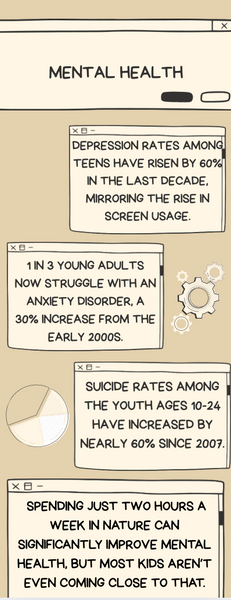
Depression rates among teens have risen by 60% in the last decade, mirroring the rise in screen usage. [1]
-
1 in 3 young adults now struggle with an anxiety disorder, a 30% increase from the early 2000s. [2]
-
Suicide rates among the youth ages 10-24 have increased by nearly 60% since 2007. [3]
-
Research shows that spending just two hours a week in nature can significantly improve mental health, but most kids aren’t even coming close to that.[4]
Instead of climbing trees, kids are climbing the ranks in video games. Instead of exploring forests, they’re scrolling through someone else’s adventures online. The outdoor industry has an opportunity not just to provide access but to reconnect people with the mental health benefits of nature. The message has to be clear: the outdoors isn’t just for fitness; it’s for mental well-being, too.
Screen Time vs. Green Time: The Battle for Movement
We are living in the most indoor generation in human history. Screens dominate our time and pulling us further from the outdoors and replacing real-life experiences with digital ones. The average American spends over 7 hours a day staring at a screen, while kids rack up more than 1,000 hours of screen time per year, yet many won’t even spend half that time outside.
This isn’t just about distraction. It’s about a fundamental shift in how we experience the world. The thrill of adventure has been replaced by digital dopamine hits. Climbing a mountain? Too much effort. Scrolling through someone else’s summit selfie? Way easier. Outdoor sports aren’t just competing with traditional indoor hobbies anymore, they’re fighting against an entire ecosystem designed to keep people inside.
The Rise of Screen Addiction
The numbers paint a clear picture: screens aren’t just a part of life; they’ve become life.
-
Teens spend an average of 8.5 hours a day on screens, while younger kids average 5-7 hours. [5,6]
-
By age 18, the average child will have spent 30,000 hours on screens; that’s four times more than they’ll spend in school. [7]
-
Less than 20% of kids play outside daily, a drastic decline from previous generations. [8]
-
The American Academy of Pediatrics recommends no more than two hours of recreational screen time per day, yet most kids exceed that before noon. [9]
Outdoor play was always a staple during childhood. That is now being replaced by social media scrolling, video games, and binge-watching. This results in a generation that’s more comfortable inside, more disconnected from movement, and less likely to develop a lifelong love for outdoor sports.
Screens Have Redefined “Fun”
Ask a kid what they do for fun, and chances are, it won’t involve running, climbing, or biking; it’ll involve a screen. The way we define entertainment has shifted, and outdoor sports are losing ground.
-
Video game engagement is at an all-time high, with over 90% of kids playing regularly. Many games simulate adventure, risk, and exploration without requiring any real movement. [10]
-
Social media has gamified everyday life. The rush of likes, comments, and shares creates instant gratification, something outdoor sports struggle to compete with. [11]
-
Streaming services have turned binge-watching into a norm. The average person spends over 1,300 hours a year watching TV and movies, the equivalent of 54 full days of screen time. [12]
Outdoor sports demand effort. They come with struggles, setbacks, and learning curves. But screens? They offer a shortcut to excitement, a risk-free way to experience adventure. The problem is, no app can replicate the feeling of sinking in powder, summiting a peak, or catching your first wave.
The Outdoor Industry’s Biggest Competitor Isn’t Another Sport… It’s Screens
For decades, outdoor/adventure sports competed with team sports. Now, they’re competing with an entire digital world designed to be addictive. If the industry wants to survive, it has to fight for attention in a way it never has before.
That means:
-
Reframing the outdoors as exciting and accessible. Outdoor sports need to feel just as engaging as what kids see on screens.
-
Making movement social. Digital spaces thrive on connection, and outdoor sports need to offer that same sense of belonging.
-
Bridging the gap between tech and outdoor experiences. If screens are here to stay, how can they be used to enhance, rather than replace, outdoor adventures?
Because the reality is, that kids aren’t going to log off on their own. If we want the next generation to choose the outdoors, we have to give them a reason to.

Work Cited
-
Vidal, Carol, et al. "Social Media Use and Depression in Adolescents: A Scoping Review." International Review of Psychiatry, vol. 32, no. 3, 2020, pp. 235–253. https://pmc.ncbi.nlm.nih.gov/articles/PMC7392374/#:~:text=There%20have%20been%20increases%20in%20adolescent%20depression,media)%2C%20which%20is%20widely%20used%20among%20adolescents.&text=Over%20the%20past%20several%20decades%2C%20adolescent%20depression%20and%20suicidal%20behaviours%20have%20increased%20considerably.
-
Osorio, Emma Kauana, and Emily Hyde. "The Rise of Anxiety and Depression Among Young Adults in the United States." Ballard Brief, Mar. 2021, https://ballardbrief.byu.edu/issue-briefs/the-rise-of-anxiety-and-depression-among-young-adults-in-the-united-states#:~:text=While%20this%20increase%20in%20both,US%20struggling%20with%20mental%20disorders.
-
Curtin, Sally C., and Matthew F. Garnett. "Suicide and Homicide Death Rates Among Youth and Young Adults Aged 10–24: United States, 2001–2021." NCHS Data Brief, no. 471, June 2023, https://www.cdc.gov/nchs/products/databriefs/db471.htm#:~:text=Data%20from%20the%20National%20Vital,and%20then%20increased%20through%202021.
-
Weir, Kirsten. "Nurtured by Nature." Monitor on Psychology, vol. 51, no. 4, Apr. 2020, https://www.apa.org/monitor/2020/04/nurtured-nature.
-
Common Sense Media. "The Common Sense Census: Media Use by Tweens and Teens." Common Sense Media, 2019, https://www.commonsensemedia.org/sites/default/files/research/report/8-18-census-integrated-report-final-web_0.pdf.
-
Duarte, Fabio. "Average Screen Time for Teens (2025)." Exploding Topics, 4 Apr. 2025, https://explodingtopics.com/blog/screen-time-for-teens#.
-
American Academy of Child and Adolescent Psychiatry. "Children and Watching TV." Facts for Families, no. 54, May 2024, https://www.aacap.org/AACAP/Families_and_Youth/Facts_for_Families/FFF-Guide/Children-And-Watching-TV-054.aspx#:~:text=Screen%20Time%20and%20Children&text=Children%20and%20adolescents%20spend%20a,Misleading%20or%20inaccurate%20information
-
Save the Children. "Children Today 62% Less Likely to Play Outside Than Baby Boomer Grandparents." Save the Children UK, 4 Aug. 2022, https://www.savethechildren.org.uk/news/media-centre/press-releases/2022/children-today-far-less-likely-to-play-outside-than-their-grandparents.
-
American Academy of Child and Adolescent Psychiatry. "Children and Watching TV." Facts for Families, no. 54, May 2024, .https://www.aacap.org/AACAP/Families_and_Youth/Facts_for_Families/FFF-Guide/Children-And-Watching-TV-054.aspx
-
Alanko, Daniel. "The Health Effects of Video Games in Children and Adolescents." Pediatrics in Review, vol. 44, no. 1, Jan. 2023, pp. 23–32, doi:10.1542/pir.2022-005666. https://pubmed.ncbi.nlm.nih.gov/36587018/
-
Bucknell University. "Instant Gratification & Its Dark Side." Bucknell University News, 2014, https://www.bucknell.edu/news/instant-gratification-its-dark-side.
-
Alam, Danesh A. "Binge-Watching and Your Health." HealthBeat, Northwestern Medicine, Aug. 2024, https://www.nm.org/healthbeat/healthy-tips/emotional-health/binge-watching#:~:text=Binge%2DWatching%20Is%20Like%20a%20Drug%20The%20release,continue%20to%20binge%2C%20your%20brain%20produces%20dopamine.
-
Baylor University. "Grip Strength of Children Gives Clues about Their Future Health, Study Finds." Baylor University News, 13 Aug. 2018, https://news.web.baylor.edu/news/story/2018/grip-strength-children-gives-clues-about-their-future-health-study-finds. Media and Public Relations+3Media and Public Relations+3Media and Public Relations+3
-
Shute, Nancy. "Kids Are Less Fit Today Than You Were Back Then." NPR, 20 Nov. 2013, https://www.npr.org/sections/health-shots/2013/11/20/246316731/kids-are-less-fit-today-than-you-were-back-then.
-
Cunningham, Susan. "Increased Use of Screen Time Causing Back Pain in Kids." UCHealth Today, 7 Dec. 2023, .https://www.uchealth.org/today/increased-use-of-screen-time-causing-back-pain-in-kids/#:~:text=posture%20with%20screens-,On%20average%2C%20American%20children%20ages%208%20to%2012%20spend%20four,neck%2C'%E2%80%9D%20Barger%20said.
Mayo Clinic Staff. "Sitting: How Does Sitting Too Much Affect My Health?" Mayo Clinic, 2023, https://www.mayoclinic.org/healthy-lifestyle/adult-health/expert-answers/sitting/faq-20058005#:~:text=They%20found%20that%20people%20who,effects%20of%20too%20much%20sitting.